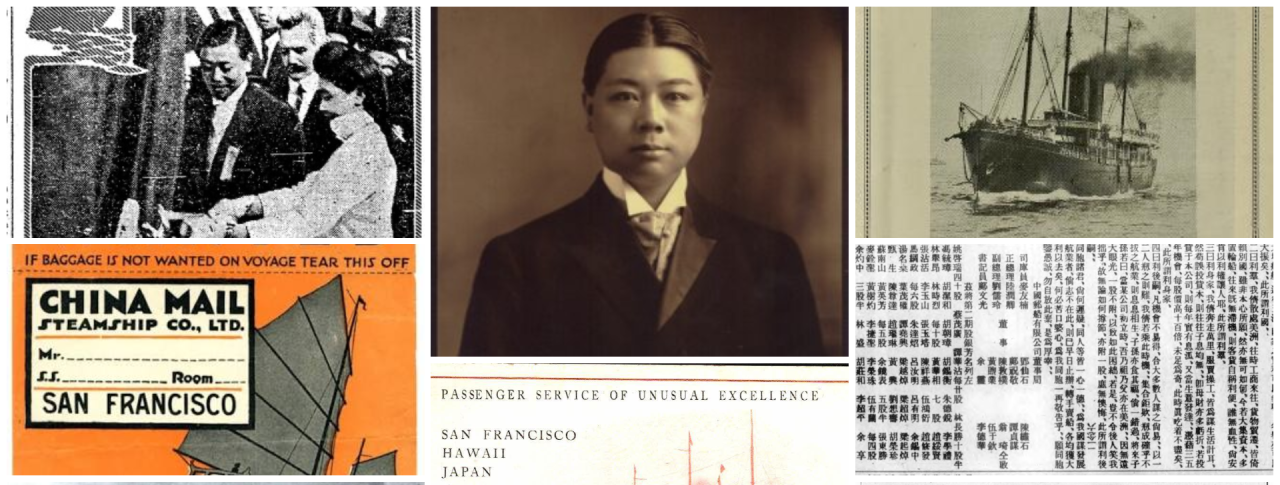
"If we let this opportunity slip away, then in the future our descendants may say: 'When the company was first established, our grandfathers and fathers were also living in America, yet because they lacked foresight and did not subscribe for even a single share, things have become as difficult as they are today.' If that were to happen, would it not bring ridicule upon our generation? Therefore, no matter how much we must economize and tighten our belts, we should each subscribe for at least one share, so that we will have no cause for shame or regret. This is what is meant by benefiting future generations."
—— Shi Jie Ri Bao, January 26, 1917.
("日利後聞,凡機會不易得,合大多數人謀之固易,以一二人籌之則難。我儕若乘此時機,集合鉅款,籌成確乎不二之航業,則息息相生,子孫亦食其福。倘一錯過,將來子孫若日,當某公司初立時,吾乃祖乃父亦在美洲,因無遠大眼光,一股不附,以致如此困難,若是,豈不令後人笑我輩乎。故無論如何撙節,亦附一股,庶無愧悔。此所謂利後嗣。" —— 世界日報,民國六年一月廿六日。)
In 1915, a group of Chinese American merchants in San Francisco launched an ambitious new steamship company in the trans-pacific trade. With capital supplied by some 20,000 enthusiastic investors, their goal was to build a company that could serve Chinese passengers and merchants with greater dignity and establish an independent stake in the routes linking California with Asia. Its ships sailed under the American flag, and its business was rooted in Chinese American commercial networks.
"What we earnestly desire and confidently expect to merit," said China Mail's president Look Tin Eli in 1916, "is the hearty good will of the American public and a good measure of their support in the way of passenger travel and freight shipments. It is hoped that their patriotic spirit will prompt them to patronize the flag of the United States, which floats from the peak of the steamer China. We have put the American flag back upon the Pacific and intend [to] keep it there."
Look Tin Eli
From the first founding of California, Chinese immigrants had played a central role in the development of the American West. Arriving in the 19th century primarily on vessels of the Pacific Mail Steamship Company, Chinese immigrants served as the driving labor force for the transcontinental railroad, worked in mines and agriculture, and created commercial networks that connected California across the Pacific.
It was just outside the coastal California town of Mendocino that the opium-trading Frolic crashed and sank in 1850, coming in from Guangzhou with a full load of porcelain and other valuables. The wreck site was scoured by the shipping company for salvageable cargo, but legend has it that the items had already been scavenged by the local Pomo people. Nonetheless, this investigation led to the commercial discovery of the coast redwood forests of the Mendocino area and the beginning of a timber trade that would drive the local economy for decades. In 1870, it was in this small town of Mendocino that China Mail Steamship Company's (中國郵船公司) founding leader Look Tin Eli (陸潤卿) was born and raised.
As a child in Mendocino, Look assisted at his father's general store. And at the age of nine, he was sent by his family to complete his studies in Chinese language and culture in Guangzhou. When Look attempted to return in 1884 he was denied re-entry as a result of the recently passed Chinese Exclusion Act (1882). In a legal case that established precedent for the landmark 1898 Supreme Court ruling on birthright citizenship (United States v. Wong Kim Ark), Look was ultimately granted re-entry to the United States and reunited with his family.
Later, as a successful banker in San Francisco, Look emerged as a community leader in the rebuilding of San Francisco's Chinatown after the monumental 1906 earthquake and fire. Unlike Guangzhou or the rest of San Francisco, Look envisioned a distinctive architectural style that came to define rebuilt-Chinatown: sloping pagoda-inspired roofs, grand balconies, and glowing lanterns. By pursuing this aesthetic, Chinese American civic leaders resisted an external push for the relocation of their community away from the city center, securing Chinatown's reconstruction in its original home.
China Mail Steamship Company
"It is believed that, at some time in the future, a war [between Japan and China] is inevitable, but the present crisis in China is of importance to America chiefly for the promise of a rapidly developing trade so vast that its possibilities can hardly be anticipated."
—— Sunset Magazine, 1909
When the last dynasty of China fell in 1911, it ended more than two thousand years of imperial rule; these political changes inspired new ideas about national identity and modernization, including among Chinese communities overseas. At the same time, tensions between China and Japan were on the rise. In 1915, the same year China Mail was founded, Japan presented the Chinese government with the infamous Twenty-One Demands, seeking expanded Japanese political and economic influence over China. These demands were widely viewed as an infringement on Chinese sovereignty, intensifying concerns about foreign influence over China's political and economic future.
Across the wide ocean, the Pacific Mail Steamship Company had long been the dominant American carrier on the China route. However, in 1915, after decades of service, the company withdrew from its transpacific operations; as new U.S. wage protections increased, the resulting higher operating costs made American-crewed ships financially unviable as compared to Japan's state-sponsored lines. Meanwhile, Japanese shipping companies, especially Toyo Kisen Kaisha (TKK), were expanding ambitiously in the Pacific. At the direction of Japan's government, the dominant position of Japan's steamship lines enabled a mercantilist trade policy favoring that country's exports. If Chinese American merchants did not act, they feared that Chinese travelers and businesses would remain dependent on companies controlled elsewhere.
In 1915, Chinese American business leaders in San Francisco organized the China Mail Steamship Company. The company's founders established its financial base and leadership in the United States, rather than depending on a partnership with the fledgling Chinese government. In doing so, they developed a business venture that was neither simply Chinese nor American, but distinctly Chinese-American. The company's first major purchase was the SS China, a historic former Pacific Mail steamship. Notably, under Look Tin Eli's direction, the company implemented a cadet program to train American seafarers and, as English-language papers reported, to "do its bit toward making more manpower for Uncle Sam."
A Short-Lived Venture
Building a steamship line is a formidable challenge even under favorable conditions; China Mail attempted to do so in the middle of the First World War, during a period of economic upheaval, and despite restrictive U.S. immigration policies. Despite many challenges, Look remained confident in the company's future and worked to assure investors and the public of its prospects. A 1917 headline in the San Francisco Examiner captured his optimism: "China Mail is Here to Stay."
Tragically, the company's leadership soon suffered major losses. In 1918, Fong Wing, one of China Mail's directors, was assassinated in San Francisco, in a case that was never fully solved. The following year, Look Tin Eli died in 1919, under mysterious circumstances after having fled to Hong Kong under threats.
Without the continued leadership of the figures who had helped establish the company, China Mail faced increasing difficulty maintaining its momentum. The company's ambitions collided with rising costs and a difficult operating environment. Despite a sustained effort to improve profitability, in 1923, China Mail fell into bankruptcy.
A Legacy Beyond Steamships
While China Mail lasted less than a decade, the company represented an extraordinary attempt by Chinese American entrepreneurs to forge their way into international ocean shipping and to establish their own position in Pacific commerce. Although China Mail did not become the enduring steamship line its founders envisioned, it represented a bold first attempt.
The generation that built China Mail also built neighborhoods and civic organizations that helped Chinese Americans establish a lasting place in American society. The creation of San Francisco's modern Chinatown and the growth of Chinese American institutions reflected a vision to create a future in America while maintaining connections across the Pacific.
More than a century later, San Francisco's Chinatown as envisioned by Look Tin Eli remains perhaps the most recognizable neighborhood in America. For generations of Americans of all ancestries, Chinese and Chinese American culture has left an enduring impact on our way of life. In this way, China Mail's brief, bold voyage across the Pacific set an ambitious course for the future, leaving a legacy for generations to come.