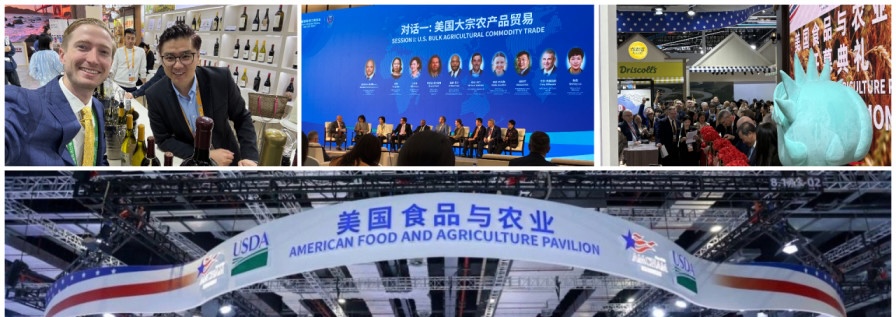
U.S. agricultural exports to China fell by more than two-thirds in 2025, and despite a series of leader-level agreements since then, recovery has been uneven. At CIIE in Shanghai, messaging from all participants was supportive, U.S. companies held the largest national footprint at the expo, and Chinese buyers were open to engagement. But importers and distributors remain hesitant to commit, citing tariff uncertainty and a cautious consumer. Meanwhile, competitors have filled the gap U.S. products left on Chinese shelves.
The central finding is that government-to-government purchase commitments may begin restoring bulk commodity flows, but specialty and consumer-ready products depend on private buyers, who need tariff and policy predictability before they will return.
The Trade Context: Steep Decline and Partial, State-Led Recovery
China’s retaliatory tariffs in 2025 hit nearly every U.S. farm export category. The US-China Business Council’s 2026 Export Report estimates total U.S. agricultural export losses to China at $15.6 billion, a 69% contraction from 2024. Soybeans alone dropped from $12.3 billion to $3.1 billion, while corn and wheat exports to China nearly disappeared. Meat products fell 44.1%. China halted purchases of U.S. soybeans from June to October 2025 and suspended export licenses for U.S. beef facilities. Meanwhile, it increased total soybean imports, buying significantly more from Brazil and Argentina.
Since the Trump–Xi meeting in Busan on October 30, 2025, the relationship has tentatively edged toward stabilization:
- November 2025: China suspended 24 percentage points of its additional tariffs on U.S. goods for one year, while retaining a 10% reciprocal duty. China committed to buy 25 million metric tons of U.S. soybeans annually from 2026 through 2028.
- May 2026: At the Beijing summit, China committed to purchase at least $17 billion per year of U.S. agricultural products other than soybeans through 2028, renewed licenses for U.S. beef facilities, and agreed to establish a U.S.-China Board of Trade.
- September 2026: At the Washington summit, the two sides agreed to a $30 billion reciprocal tariff-reduction framework and extended the trade truce to January 10, 2027. The Board of Trade launched a working group on agricultural market access. On September 28, China’s Ministry of Commerce proposed a list of U.S. farm products eligible for tariff cuts, including corn, wheat, sorghum, meat and dairy; soybeans were excluded.
The recovery so far is concentrated in state channels. U.S. traders report that recent soybean purchases were made by state-owned COFCO and Sinograin, while U.S. soybeans still face a 13% total duty against 3% for Brazilian supply. That margin is difficult for private crushers to absorb. China bought all 12 million metric tons of U.S. soybeans it had agreed to purchase through August 2026, and USDA data show strong bookings for the new marketing year. However, private crushers have largely stayed on the sidelines, and Chinese buying slowed again in the fall. USCBC reads the exclusion of soybeans from the first tranche of tariff relief as a sign that China is using its dominance in soybean demand as a strategic asset in negotiations.
The longer-term trend is also significant. China sourced about 20% of its soybeans from the United States in 2024, down from 41% in 2016. Each round of trade conflict has accelerated China’s diversification of supply.
Specialty Crops: A Hard Nut to Crack
High-value specialty crops have been hit especially hard because they rely on private buyers rather than state purchasing. USCBC data show U.S. fruit and tree nut exports to China fell 83.5% in 2025, from $0.9 billion to $0.2 billion, a steeper decline than any farm category except poultry. California, the largest producer of these crops, lost more export-supported jobs than any other state: 18,697 across all sectors.
Research from the University of California’s Giannini Foundation found that the value of California’s top 13 agricultural exports to China fell from an average of $1.55 billion a year in 2020–2024 to $554 million in 2025, a 64% decline. Pistachio exports fell by about $478 million and almond exports by about $228 million.
Data compiled by USDA’s Agricultural Trade Office in Shanghai show U.S. shelled almond exports to China falling from 24,893 metric tons in 2023 to 3,017 metric tons in 2025. Over the same period, Australian shelled almond shipments to China roughly doubled. By 2025, Australia supplied nearly 90% of China’s in-shell almond imports. This shift is also reflected on the CIIE floor, where Australian companies’ exhibits in 2026 grew 25% to their largest exhibit size yet, according to Xinhua. As Giannini Foundation economist Colin Carter has noted, rebuilding California’s lost market share could take years and significant market-development investment.
The shift in sourcing patterns is visible at the retail level. At a Walmart store in Shanghai, a Walmart China private-label product (Marketside, 沃集鲜), a high-protein drink powder made in Shandong, advertises “imported Australian almonds.”
What CIIE Showed
Launched in 2018 and hosted by China’s Ministry of Commerce and the Shanghai municipal government, CIIE is positioned as the world’s first national-level expo dedicated to imports. The 2026 edition drew 4,142 overseas exhibitors from participants representing 162 countries, regions and international organizations, across more than 440,000 square meters. For the eighth consecutive year, U.S. companies occupied the largest exhibition area of any country, at more than 50,000 square meters, up 1,500 square meters from 2025.
The American Food and Agriculture Pavilion, co-organized by the American Chamber of Commerce in Shanghai and USDA, featured 18 booths representing 40 associations and companies, from commodity groups to small consumer brands. The U.S.-China High-Level Dialogue on Agriculture, held on the expo’s sidelines, opened with remarks in support of agricultural trade from officials of both countries, followed by two panels:
- Bulk commodities: Moderated by Manuel Sanchez, China country director for the U.S. Grains and BioProducts Council, this panel brought together representatives of eight bulk commodity groups. The associations outlined priorities for supporting market access, including addressing non-tariff barriers that prevent certain products from being received into the China market.
- Specialty and consumer-ready products: Moderated by Xin Li of AmCham Shanghai, this panel featured associations including the Almond Board of California and the Wisconsin Department of Agriculture, Trade and Consumer Protection. Speakers emphasized innovation, food safety and quality as differentiators for U.S. products, and focused on segments where new growth is possible. The US Rice Producers Association, for example, described efforts to distinguish American rice by highlighting the range of products made with the crop, including beverages and snacks.
The tone across both sessions was constructive. The policy track and the commercial track, however, are moving at different speeds.
Buyer Sentiment at the Expo
Conversations with Chinese importers and distributors at the expo, conducted primarily in Mandarin, pointed to three consistent themes:
- Domestic demand is cautious. Restrained consumer spending has made retailers and distributors conservative about adding new products, regardless of origin. This compounds the tariff disadvantage for U.S. goods competing against duty-free alternatives.
- Interest remains. Buyers were open to discussing premium U.S. food products and the logistics of bringing them to market. U.S. quality and food-safety credentials still carry weight.
- Uncertainty is the biggest concern. Buyers asked whether tariffs would change again and what would happen when the truce expires in January 2027. Having been burned by sudden disruptions in 2025, buyers are reluctant to commit to new suppliers or product lines without visibility beyond a few months.
Implications for U.S. Companies
- State buying can move bulk volumes quickly, but specialty crops and consumer-ready foods depend on thousands of private purchasing decisions. Tariff parity with competitors, rather than headline purchase targets, will determine whether those buyers return. Addressing remaining tariffs and longstanding non-tariff barriers such as facility registration and sanitary and phytosanitary approvals is expected to be a top priority for the Board of Trade’s agricultural working group.
- Predictability is itself a market-access issue. The January 10, 2027 truce expiry is the next decision point. A multi-year framework, rather than short truce extensions, would do more to bring private buyers back than marginal rate changes.
- Lost share will not return automatically. Where competitors hold free-trade-agreement advantages, as Australia does in almonds, U.S. suppliers face a long rebuild even after tariffs fall. Sustained market-development investment, including USDA and state-level programs, and continued visibility at venues like CIIE will be necessary to regain position.
- In-person engagement still makes an impact. U.S. companies’ leading footprint at CIIE and the strong turnout at the agricultural dialogue signal continued commitment to the market. Chinese buyers’ willingness to engage suggests commercial relationships can begin recovering once policy conditions allow.
Sources
- US-China Business Council. “US Exports to China 2026: Goods Exports to China and the Jobs They Support, by State.” October 2026.
- Carter, Colin A., Sandro Steinbach and Yasin Yildirim. “2025 U.S.-China Trade Conflict Harms California Agriculture.” ARE Update 29(3), UC Giannini Foundation of Agricultural Economics, 2026.
- USDA Foreign Agricultural Service, Agricultural Trade Office Shanghai. “Almond Market Update 2026” (CH2026-0096).
- Reuters. “China to buy at least $17 billion in US agricultural products annually, White House says.” May 17, 2026.
- S&P Global. “US, China agree on $30B tariff reduction framework; expand farm trade.” September 28, 2026.
- S&P Global. “China’s tariff cut plans skip soybeans, spurring hopes for higher buys of other US farm goods.” October 1, 2026.
- S&P Global. “US says trade truce with China extended till Jan. 10, 2027, ahead of Trump-Xi meet.” September 24, 2026.
- Xinhua / China Daily. “9th China International Import Expo opens in Shanghai.” November 5, 2026.
- 国务院关税税则委员会. 《关于调整对原产于美国的进口商品加征关税措施的公告》(税委会公告2025年第10号). 2025年11月5日.
- 新华社. 《商务部公布中美贸易理事会和“300亿对300亿”对等降税框架有关情况》. 2026年9月28日.
- 新华社. 第九届进博会筹备情况报道 (4142家境外企业、澳大利亚企业参展面积扩大25%). 2026年11月4日.