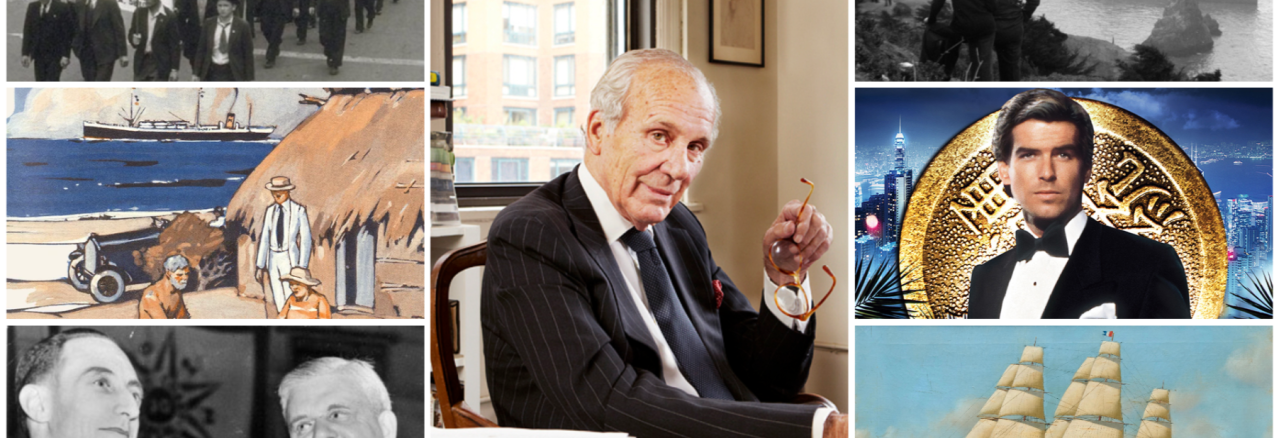
"We have nothing else with which to build the future except the lumber of the past — history exploited as natural resource and applied technology, telling us that the story painted on the old walls and printed in the old books is also our own."
—— Lewis H. Lapham II, Lapham's Quarterly
One of the oldest traditions of trade on the sea is the noble house: the families whose names and fortunes pass from one generation to the next. Aponte, Chang, Møller, Saade, and Tung are among a few of the houses of modern ocean shipping. Through the tides and tempests of the shipping business, these families have remained influential, carrying their traditions from one era to the next. Their dynamics were perhaps best captured in the fictional setting of James Clavell's 1981 novel Noble House, set in the hyper-competitive world of corporate Hong Kong.
In over-the-top paperback drama style, the novel recounts the wealthy, almost aristocratic, Struan family's battle to maintain power and legacy in a changing global economic system. The scion Ian Dunross takes over the family in the mid 20th century by reciting the secret instructions of the trading company's Scottish founder whose legacy "shall bind every tai-pan that succeedeth me and he shall read it aloud and shall swear before God." Dunross then makes the bold step of taking the family company public, only to find himself contending with a charismatic and crafty American billionaire offering to partner with Struan for international expansion.
Great families are still active and respected within the modern shipping industry. However, since the 1980s, a pivot from the physical economy to financialization — accelerated by deregulation, containerization, and the rise of flags of convenience — has diminished the influence that many shipping houses once wielded, even as wealth itself has become vastly more concentrated. Ironically, fortunes have grown ever larger, yet increasingly abstract. The Lapham dynasty of San Francisco would find itself caught between these two worlds.
The Dearborn and Lapham Families
The call of the sea ran in the Dearborn line for generations. Through the age of sail, the New England family served as captains and shipping agents in the China Trade, but they always had dreams of building a shipping line of their own. In the 1880s, George Dearborn tried unsuccessfully to convince investors to back his proposal to create an innovative steamship line in the U.S. intercoastal trade, which linked the East and West coasts. Despite the advantages of steam technology, in the conservative tradition of ocean shipping, the intercoastal trade remained dominated by sailing ships for decades after the invention of the steamship.
When George Dearborn married into the wealthy Lapham family, he gained access to the capital to turn his ambitions for a new American shipping line into reality. Finally, following the U.S. annexation of Hawaii in 1898, the Dearborn-Lapham family found their ideal investment opportunity. In 1899, with the financial backing of his new brother-in-law, Lewis Lapham, Dearborn founded the American-Hawaiian Steamship Company (A-H). The first four A-H ships were named the American, Californian, Hawaiian, and Oregonian. These vessels made the route from New York to California in 50 days, a month faster than the fastest clipper sailing ships.
A-H soon established itself as a leader of the steamship era, and was credited with being the first to introduce scheduled liner shipping to the U.S. intercoastal trade. The company emerged as the leader of what would come to be known in San Francisco as the "Big Three" shipping houses: A-H, Matson Navigation Company, and Dollar Steamship Line. Under George Dearborn's leadership, American-Hawaiian prospered, becoming the largest American-flag shipping company by World War I.
The Loss of the Hawaii Trade
Critics judged that George Dearborn made only one serious blunder in his management of American-Hawaiian: in 1916, he suspended his Hawaii service in favor of chartering the fleet into the North Atlantic trade. By turning away from the Hawaiian sugar exporters in this time, Dearborn lost standing to Matson and was never able to regain this lane of business. Looking at this period from another perspective, however, industry historian Michael Nerney highlights in his history of Williams, Dimond & Co. that the redirected A-H fleet would go on to make 145 voyages in support of the U.S. war effort, carrying 125,000 troops, 300,000 horses and mules, and 625,000 tons of supplies to France.
After the death of the company's founder, Dearborn, in 1920, subsequent leadership struggled to maintain course through a difficult period of post-war instability in the shipping business. A-H never dropped "Hawaiian" from its company name, even as this label no longer accurately described the company's services. Roger Dearborn's son Henry Dearborn lasted as successor for only three years; another leader, Cary Cook, took the role for two years before his own abrupt resignation. This instability in leadership, alongside difficult market conditions, was a great strain for the company.
As A-H struggled to find its way without its founder's guiding vision, Matson flourished. From the passing of the Jones Act in 1920 through 1930, Matson expanded beyond shipping into an integrated passenger and tourism business. In 1925, it established Matson Terminals to handle stevedoring and terminal services. And with American-Hawaiian cleared from Hawaii, Matson developed its signature "White Ship" luxury passenger liners for travel to Hawaii and the South Pacific, along with a hotel brand and an elaborate tourism marketing campaign. Meanwhile, A-H drifted on an uncertain course.
The Lapham's Son of Fortune
George Dearborn's nephew, Roger Dearborn Lapham, did not have an obvious shipping pedigree; the Lapham family fortune had been built on oil. Yet a voyage to Hawaii at age seventeen sparked in the young scion a lifelong love of the sea. He traveled widely, studied the humanities at Harvard, and, upon graduation in 1905, joined American-Hawaiian as a cargo checker. He later moved to join the company's West Coast agency, Williams, Dimond & Co., in his favorite city, San Francisco.
Lapham remained in the shipping business for the next two decades, keeping a relatively low profile. The extent of his day-to-day professional involvement during these years is unclear. Newspapers mentioned him far more often for his competitive golfing along the California coast than for his work at the company. Though the sea-loving Lapham held several titles at American-Hawaiian, he did not yet appear to possess the qualities one would expect of a leader, apart from the considerable advantage of being the founder's nephew.
While Roger Lapham enjoyed a subdued life of leisure throughout his early years, he experienced a rebirth in the furnace of World War I. Up to that time, he had been described as solemn in thought and behavior, shy in conversation and cautious in his dealings with money. However, in the summer of 1918, then a 35-year old captain of infantry with the American Expeditionary Force, Lapham was reported missing and presumed dead after his battalion was overwhelmed by German poison gas during the Oise-Aisne offensive. Six weeks passed before Lapham was found in the hayloft of a French barn, where a farmer's wife nursed him back to life with soup. By the time he was strong enough to walk, Lapham had lost half his body weight and shed his former self. As his grandson recalled:
He returned from France reconfigured in character, akin to Shakespeare's Sir John Falstaff, extravagant in his consumption of wine and roses, passionate in his love of high-stakes gambling on the golf course and at the card table, persuaded that the object of life was nothing other than its fierce and close embrace.
When given the opportunity to take leadership of A-H in 1925, Roger Dearborn Lapham proved, in spite of his Ivy League background, that he had discovered the Dearborn family spirit for bold action at sea. Lapham moved the company's headquarters from New York to San Francisco, recognizing the city's importance in the professionalized American West, and brought the company's shipping agency functions in house. He then acquired a competitor, the Williams Line, to consolidate A-H's position in the intercoastal trade. Shortly thereafter, Lapham brokered a successful new joint venture in the South Pacific trade with Matson in 1928, called Oceanic & Oriental Navigation Co., with each holding 50% of the new company's stock.
Money for Stockholders
Following these professional successes, Lapham's profile in the industry grew and he was frequently quoted by the New York Times as an expert on international shipping affairs. As the stock market climbed, the Times commented on the surge of corporate mergers across virtually every segment of American industry, writing: "Plans are now shaping in Wall Street for a large number of new consolidations, and it has been frequently remarked that 1928 may become known as the 'big merger year.'" As A-H's intercoastal service thrived on the new Panama Canal route, cutting transits between the U.S. East and West Coast even further than before, Lapham was invited by the University of California to write an article on the canal's impact on global trade in their journal Current History.
In a symbolically important moment, Roger Lapham served as speaker for the Pacific Traffic Association's annual Steamship Night banquet, held at the Palace Hotel in August 1929. In earlier years, the San Francisco banquet had been a source of raucous entertainment, including a sensationalized liquor raid by federal prohibition agents when the event was held on the steamship Matsonia. Bringing a more formal, professional style to the group, Lapham spoke before an audience of many independent shipping lines, laying out the case for corporate consolidation under public stock ownership:
Unquestionably, the primal object of the individual in business is to make money for himself, and it is equally essential that the officers of a corporation make money for the stockholders. But, there is a growing realization, particularly on the part of bigger business, that the best way to make money for its stockholders over a period of years, is through the goodwill of its customers, gained by efficient performance of the services required.
As a historian taking the long view of maritime commerce, Lapham predicted that independent steamship lines could no longer thrive in the increasingly competitive transportation market. As a result, larger, professionally managed shipping corporations would emerge, following the trend in other American industries. Lapham's proposal reflected a widely shared faith in corporate growth and capital markets. Only shortly afterward, the nation discovered how fragile that financial system really was.
From Black Thursday to Bloody Thursday
Two months after Steamship Night, the optimism that had propelled the American stock market through to its peak came down suddenly in what is known as Black Thursday, October 24, 1929, the catastrophic start of Wall Street's crash. By 1932, after three years of economic collapse, the market hit the bottom of the Great Depression. As Lapham's wife Helen Abbott Lapham recalled in her memoir Roving with Roger, Lapham returned to their Pacific Heights home one night from work after a day when their company's stock price dropped almost to nothing. She wordlessly put a highball cocktail in his hand as they sank into pensive silence. Prohibition or not, everyone needed a drink now.
Their young son Roger Jr., imagining the stock market in the terms of his algebra homework, asked, "What do you do if it goes below zero — put a minus sign in front of it?" Never losing his sense of humor, Roger Lapham laughed, "Well, we hope it won't come to that, son."
Outside of the Lapham home, the financial crisis of Wall Street translated not simply to lost stock value, but to massive unemployment and widespread poverty, with some forced to live in squalid roadside tents. Frustrated urban workers and agricultural laborers mobilized into large-scale strikes. In San Francisco, these events escalated into the clash remembered as Bloody Thursday, July 5, 1934, and the tragic deaths of two longshoremen: Nicholas Bordoise and Howard Sperry, the latter a World War I veteran.
In private social clubs, San Francisco's industry leaders spoke with great concern over the intensity of labor disputes, but were unsure of how to react. Employers sought the heavy hand of federal anti-strike intervention, but the administration of President Franklin Roosevelt instead pressed for arbitration. On the waterfront, longshoremen had rallied behind the leadership of the firebrand Harry Bridges. And when employers in 1936 attempted to roll back some of the concessions of 1934, Bridges made a public challenge for someone from the shipowners' side to come forward and publicly debate with him. At first, nobody dared.
Suddenly, Lapham stepped forward to volunteer. To the bewilderment of his social circle, the Harvard-educated Lapham not only accepted the invitation to debate, but relished the opportunity for a contest of ideas. Word of this Bridges-Lapham debate quickly generated such a buzz that people traveled into San Francisco from across the state to watch. This spectacle was even picked up in popular culture in the 1938 American novel Journey to the West, where a newspaper man tells his employee:
"You'd better go along now, and use your head when you listen to Bridges, and remember you're not a thickskull who's going to try to tear down honest business principles, but a man who's on his way up and is interested in studying the methods employed by rabble-rousers like Bridges to move men who haven't the brains you and I have."
"I-I guess I never exactly thought of it in that light, Mr. Cobb."
"You will, though. That's the reason some people have great homes and fine cars and dough to spend; and others have to go on strike and starve at Christmas. Some think. Some don't."
Striding onstage to a crowd of some 12,000 attendees who were almost entirely supportive of Bridges, Lapham defended the shipowners' position with confidence. He outlined the challenges that the shipowners faced, navigating between the interests of labor, government, and stockholders. By the end of his remarks, many were struck by Lapham's willingness to make his case so directly, with courage and conviction, in the midst of a polarized political environment. Harry Bridges in turn laid out the case for worker-run union hiring halls to end employer discrimination, asserting that workers needed collective control to secure fair and safe conditions.
Perhaps no one on the side of organized labor was persuaded to abandon their position, nor were shipowners converted to Bridges' view. But by speaking with opponents face-to-face and engaging with opposing viewpoints, the event provided a release valve for society's tensions. Bridges and Lapham's debate, which the San Francisco Chronicle praised as "a typically tolerant San Francisco gathering," signaled that fierce disagreement did not necessarily preclude mutual respect, and that direct engagement would produce a more constructive result than disengagement; this first debate and the events that followed demonstrated that society's disagreements could remain visible, legitimate, and nonviolent.
In the following year, Roger Lapham was elected chairman of the board of American-Hawaiian, turning executive control of the firm over to John Cushing. However, the move did not mark a retreat from public life. By the time the United States entered World War II in December 1941, Lapham had become one of San Francisco's most prominent business figures. His experience as a shipowner and his position as chairman of the American-Hawaiian Steamship Company gave him particular standing in a city whose fortunes remained closely tied to the waterfront.
In the beginning of the war, Lapham was recruited to serve on the newly created 12-member National War Labor Board. Participants pledged no strikes or lockouts for the duration of the war, and that disputes would be resolved peacefully. Working across political lines with the New Deal Democrat administration of President Franklin Roosevelt, Lapham collaborated with his fellow board members, including industry, labor, and the public, in addressing wartime labor-management disputes.
When Secretary of Labor Frances Perkins, the first female U.S. cabinet member, visited San Francisco, Lapham hosted her for a dinner discussion at his home. Perkins was a firm Progressive whose views on workers' rights were shaped by the personal experience of having witnessed the tragic Triangle Shirtwaist Factory fire in 1911. Since the 1930s, Perkins and Lapham had sparred in frequent debates, but through their mutual respect they achieved a rapport despite their differences of opinion. At dinner that night, the conversation with Lapham and his invited group of industry friends was spirited, lasting until one o'clock in the morning. When Perkins finally left, Helen Lapham recalled the Secretary of Labor's sense of humor:
I went over to say goodbye to her, and told her she must feel as Daniel did when he was in the lions' den. "Oh, but Mrs. Lapham," she said, "I knew they weren't going to eat me, and they all roared so charmingly, I assure you I really enjoyed it."
Mayor Roger Lapham
By midway through the war, Lapham was ready to bring his ideas about business and civic administration back home to San Francisco. Running as a business-oriented civic leader, he won the November 1943 election for San Francisco Mayor and resigned from American-Hawaiian. As mayor, Lapham took on City Hall with the same fire with which he approached business. One of his major initiatives was to have the city acquire the multiple, privately owned Market Street Railway systems and consolidate them into a single municipal railway. Lapham threw himself into this campaign, delivering dozens of speeches, personally calling residents, and even staging a horsecar ride down Market Street in a dramatic parody of the antiquated nature of the cars. Despite the success of many of his initiatives, Lapham's attitude seemed to his opponents to be abrasive and disrespectful of the traditions that gave San Francisco its distinctive character.
In his approach towards what he established from the start would be a single-term mayorship, Lapham was driven to only actions he believed necessary, staunchly opposed to "do good" stunts of any kind. In 1946, Lapham approved a streetcar-fare increase, which galvanized his opponents to gather enough signatures to force San Francisco's first mayoral recall election. Although Lapham survived the recall, only about six months later he plunged into yet another transportation battle: this time, he crossed a red line in San Francisco by recommending that the city eradicate cable cars, citing their high operating costs and the risk of cable failures. In response, Lapham's opposition organized into the influential Citizens Committee to Save the Cable Cars, a campaign that attracted national attention and mobilized the action of San Francisco voters, saving the cable cars' place as an iconic feature of San Francisco.
As mayor of San Francisco, Lapham focused not only on internal reforms but also on strengthening the city's global connections. In April 1945, San Francisco hosted the historic United Nations Conference on International Organization, bringing more than 3,500 delegates and staff from 42 countries to the city. Lapham built a broad coalition to make the event a success, including appointing his former debate opponent Harry Bridges to the UN advisory committee. As Bridges later recalled, "He was a formidable adversary, but he never held a grudge… and if you know how his buddies felt about me, you know that took GUTS." The conference was a highlight of Lapham's public career and helped launch him onto the international stage.
After completing his term as mayor, Lapham moved abroad with his wife Helen to take a position as chief of the US economic aid mission to China from 1948 to 1949. In China, Lapham served in the role of economic support of Chiang Kai-shek's Nationalist government in the final year of the Chinese Civil War, as the Nationalists' position rapidly collapsed and Communist victory grew increasingly inevitable. Despite the futility of this position, Lapham maintained his characteristic humor and embraced his time in the country, which his wife recalls was full of frequent "ganbeis" (cheers) with their hosts. There were also positive moments of cultural connection; Helen Lapham bonded with Ouyang Ju (欧阳驹), the mayor of Guangzhou (Canton), over their shared family history in the China Trade:
I asked him if he had ever been to America, and he said no, but his grandfather had been there in 1848. I said, "What a coincidence, for my grandfather was in Canton in 1846!" My grandfather, Thomas Wade Abbot, had signed on as a ship's clerk at the age of 19, and had sailed to China. He was gone almost a year and had kept a diary that I still possessed.
When the victory of Mao Zedong's forces finally forced the Laphams to return from China, Lapham wrote a thoughtful government memo strongly advising against military intervention. Instead of pursuing a war to contain Communism, Lapham advocated maintaining commercial ties with China. "Let us show that we Americans," he wrote, "are intelligent and flexible enough to meet conditions as they are and not as we want them to be." He envisioned that long ties of friendship between the two nations would ultimately transcend these stresses, and that the forces of commerce would naturally bring China back out of Communism.
The Fall of the Noble House
In 1947, American-Hawaiian's President John Cushing left the company to join Matson. Like his father before him, Lewis A. Lapham was not a natural choice to step into the presidency. He was best known for his work in labor relations through the Waterfront Employers Association and his eloquent waterfront writing. Having originally aspired to be a career writer, Lapham had brought the wit of Yale to the local waterfront newspaper beat. As the new Lapham joked to the Times when he was elevated to the presidency of American-Hawaiian: "I'm being thrown off the dock to see if I can swim."
Unfortunately, the analytical and skeptical Lewis A. Lapham was hesitant to take any new commercial action until the postwar trade patterns became clearer and he could confirm the future status of government shipping subsidies. He struggled to maintain the company's intercoastal operations through years of heavy losses and did not branch out A-H into new trades. Betting that Korean War-era freight rates would continue, the company acquired six surplus ships. When the distressed intercoastal trade fell, losses mounted, and the company finally suspended service in 1953.
As a last-ditch measure, Lapham brought in shipping magnate Daniel K. Ludwig as an investor, seeking his expertise in foreign flag shipping. After a contested takeover in 1955, Lewis A. Lapham resigned and the Laphams sold their shares, giving Ludwig full control. Thus, American-Hawaiian's half century of operations finally came to an end. Lewis A. Lapham moved his family to New York and transitioned into a successful career in banking.
Meanwhile, Ludwig sold off the company's ships in 1956, ending its shipping business, but kept the corporate shell as a holding company for unrelated ventures until its final liquidation in 1968. When Forbes first began tracking billionaire wealth in 1982, Ludwig was the richest person in America, with an estimated fortune of $2 billion, almost $7 billion in today's dollars. Even that extraordinary sum, however, would be dwarfed by the concentration of wealth at the top of today's society, where the largest personal fortunes are two hundred times greater.
The Foundation of Our Common Enterprise
Later in life, Roger Lapham's grandson, Lewis H. Lapham II, reflected on the influence of his family's experience in the shipping business. He particularly recalled the early impression made by the wreck of one of the family's ships, the Ohioan, when he was a young boy. Although all of her crew survived, the wreck represented a major loss for the American-Hawaiian Steamship Company. For the next three years, his contemplative father Lewis A. Lapham would often take the younger Lewis by the hand along the cliff overlooking the wreck on Seal Rocks, where the boy could ponder firsthand the useful lessons of the disaster's physical remains.
To foster my acquaintance with the family's history and changing fortunes, he spoke of distant ancestors sailing from the port of Boston and the Gulf of Maine in the early-nineteenth-century China trade, of my great-grandfather's organizing the American-Hawaiian Steamship Company in 1899 not because of the money in the business but because of the romance.
The last Lewis dove wholeheartedly into his love for literature and history, becoming a nationally influential writer. Like generations of Laphams before him, Lewis H. Lapham II benefited from elite education and family resources, but he used this position to demystify the culture of privilege for the broader public. Especially critical of finance and rentier wealth, Lapham highlighted that income from rents, dividends, and interest had become ever more prominent while manufacturing's share of GDP declined.
While he was a product of a different era in America, Lewis H. Lapham II, like his grandfather, believed in civil discourse, possessing the confidence to stand publicly behind unpopular convictions. Unlike his forefathers — defenders of institutional leadership and upholding the social order — Lapham challenged social hierarchy and questioned the rising concentration of wealth as it began to intensify in the 1980s. Throughout his many writings, Lapham described the cult of American stock-wealth as a source of distorted values, class division, and misplaced faith in money:
But money in and of itself cannot run the world. Not, God forbid, through any fault of its own but because, sad to say and more's the pity, money in and of itself is mindless, no more capable of making a fair exchange of value than a dog snatching a bone from another dog.
In the days of the American-Hawaiian Steamship Company, shipowners associated with one another in private social clubs; nonetheless, the city's social and economic worlds remained more closely intertwined, with people from different walks of life often meeting face-to-face. Today, wealth is more concentrated yet less visibly centralized than it was in 1929, even as inequality has returned to a level comparable to that on the eve of the Great Depression. Nonetheless, our present age is not the first in which we have faced large, complex challenges. In a vision of hope, Lewis H. Lapham II believed that the stories of our old books illuminate a path towards a nobler future.
Lapham's Quarterly: Selected Articles
- "Sea Change," Lewis H. Lapham II
- "The Sea of Islands," Andrea Wolf
- "A Winelike Sea," Caroline Alexander
- "Open Waters," Simon Winchester
Lapham Generations
- Lewis Henry Lapham (1858–1934) & George Dearborn (1858–1920)
- Roger Dearborn Lapham (1883–1966)
- Lewis Abbot Lapham (1909–1995)
- Lewis Henry Lapham II (1935–2024)